
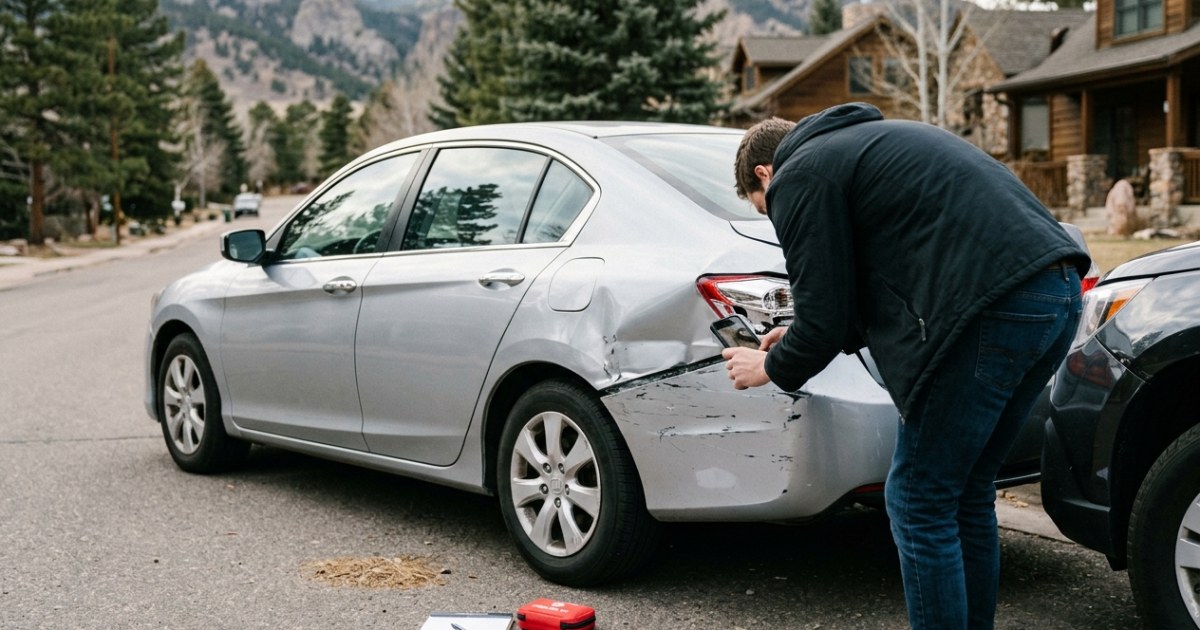

The two days after a crash are the worst time to have to make good decisions. You are sore, your car is wrecked, you are on the phone with people you have never met, and somebody wants a recorded statement before you have even seen a doctor. Almost nobody is at their sharpest.
So here is a plain checklist for those first 48 hours. None of it requires hiring anyone. Most of it takes a few minutes and protects you whether you end up with a claim or not.
In the first hour: safety, then a police report
Get out of the travel lane if the cars can be moved and it is safe to move them. Then call the police.
Colorado law is not vague about this. Drivers are required to immediately report a crash that involves injury, death, or damage to property, and to give their name, address, registration and insurance information to the other people involved (C.R.S. 42-4-1606 and 42-4-1603). Calling it in is not an accusation against anyone. It is what the statute asks you to do.
In some places, especially when there are no apparent injuries and traffic is heavy, an officer may not come out. That is common and it is not the end of the world. Ask the dispatcher or the agency how to file a report yourself. Many Colorado agencies, including the Colorado State Patrol, will take a report after the fact at a station or through an online form. Do it within a day or two while the details are fresh.
Get the report number before you leave the scene if an officer does respond. It makes everything later easier.
The same day: get checked by a doctor
We say this in every context and we mean it here: get examined, even if you feel like you can walk it off.
There are two reasons. The first is your health. Adrenaline is very good at hiding things for a day or two, and some injuries, particularly to the neck, back and head, announce themselves later. A doctor is the right person to tell you what is going on in your body. We are not, and neither is an adjuster.
The second reason is that a gap between the crash and your first medical visit is the single most predictable thing an insurance company will point to. The argument writes itself: if you waited nine days to see anyone, how hurt could you have been? It is not a fair argument, because people delay care for all sorts of ordinary reasons, including not wanting to spend the money. But it is the argument you will hear, and an urgent care visit on day one takes it off the table.
Tell the provider every part of you that hurts, not just the worst one. Records only contain what you say.
Before you leave the scene: photos and names
Your phone is the best evidence-gathering tool you will ever have. Take more than you think you need:
- All four corners of every vehicle, damaged or not, plus a wide shot showing where the cars ended up
- License plates, and the other driver's insurance card and driver's license
- Skid marks, debris, broken glass, the position of the sun, the traffic signal, any obstruction to the view
- Street signs or a cross street, so the location is provable later
- Your own visible injuries, that day and again over the next week as bruising develops
Then get the name and phone number of anyone who stopped. Witnesses are easy to find in the first ten minutes and nearly impossible to find in six months. If a business, a bus, or a delivery van was nearby, note it. Cameras get overwritten fast, often within days, so the sooner someone asks for that footage the better.
Day one or two: report to your own insurer, carefully
Your own policy almost certainly requires you to notify the company promptly. Do that. Give the facts: when, where, who, which vehicles, that you are being evaluated medically.
While you are on the phone, ask one specific question: do I have medical payments coverage, and how much? Colorado requires auto insurers to offer med-pay coverage unless the customer rejects it in writing, so a lot of people have it and do not know it. Med-pay pays for treatment regardless of who caused the crash, and it does not require you to prove anything first. Ask the same question about uninsured and underinsured motorist coverage, which matters enormously if the other driver has little or no insurance.
What the other driver's insurance company is going to ask
Expect a call quickly, sometimes within a day. The adjuster will be pleasant. That is not a trick, it is just their job, and being rude to them accomplishes nothing.
What you should know is what each request is actually for:
- A recorded statement. You are not required to give one to the other driver's insurer. It is being taken while you do not yet know the full extent of your injuries, and "I'm okay, just a little sore" is a sentence that gets read back later. It is completely acceptable to say you will provide information in writing once you have seen a doctor.
- A blanket medical authorization. A broad release can open your entire medical history, not just treatment for this crash. You can decline to sign a general one.
- A quick settlement offer. An early check feels like relief when bills are landing. The problem is that settling closes the claim. If an injury turns out to need imaging, injections or surgery, there is no reopening it.
A safe, polite answer to all three sounds the same: "I am still being treated and I am not ready to discuss my injuries. Please put your request in writing."
Why the clock matters in Colorado
Forty-eight hours is not a legal deadline. But the real deadlines are shorter than people assume, and missing one usually ends a claim no matter how strong it was.
- Most motor vehicle injury claims: three years from the date of the crash, under C.R.S. 13-80-101.
- Most other negligence claims: two years, under C.R.S. 13-80-102. Whether an incident counts as a motor vehicle case is not always obvious, which is why the shorter assumption is the safer one.
- Claims against a government entity: the Colorado Governmental Immunity Act requires written notice within 182 days of the discovery of the injury, C.R.S. 24-10-109. That is under six months, and it applies to things like a city vehicle, an RTD bus, or a dangerous condition on public property. This deadline surprises people constantly.
A case filed one day late is generally over. Courts have very little discretion on this, and the insurance company's lawyers will raise it immediately.
One more Colorado rule worth knowing while memories are fresh: this state uses modified comparative fault, C.R.S. 13-21-111. If you are found partly responsible, your recovery is reduced by your share, and if you are found 50 percent or more at fault you recover nothing. That is exactly why the scene photos and the witness names matter so much. Fault gets argued later using evidence that only exists if someone collected it in the first hour.
The short version
- Call the police and get a report number, or file a report yourself within a day or two.
- See a doctor today, and describe everything that hurts.
- Photograph everything, and collect witness names and numbers before people drive off.
- Notify your own insurer and ask about med-pay and UM/UIM coverage.
- Be polite to the other insurer, give no recorded statement, sign no blanket medical release, and accept no quick check.
- Keep a folder: bills, mileage to appointments, days missed at work, and a few lines each week about what you cannot do yet.
That last one sounds like busywork and it is not. Months later, the difference between a claim that is taken seriously and one that is not is often just documentation that somebody bothered to keep.
Frequently asked questions
Do I have to call the police after a minor fender bender in Colorado?
Colorado law requires drivers to immediately report a crash involving injury, death or property damage, and to exchange name, address, registration and insurance information at the scene (C.R.S. 42-4-1606 and 42-4-1603). If no officer is dispatched because there are no apparent injuries, ask the agency how to file a report yourself. Many Colorado agencies, including the Colorado State Patrol, accept a report at a station or through an online form, and filing one within a day or two is far better than having no official record at all.
I felt fine at the scene but I hurt now. Is it too late to see a doctor?
No. Soreness that shows up a day or two later is common, because adrenaline masks a lot at the scene, and neck, back and head injuries in particular often announce themselves late. Go get examined now rather than waiting to see if it passes, and tell the provider about every part of you that hurts, not only the worst one. The longer the gap between the crash and the first visit, the more likely an insurance company is to argue the injury came from something else.
Do I have to give the other driver's insurance company a recorded statement?
You are not required to give a recorded statement to the other driver's insurer. You are generally required to cooperate with your own insurance company under your policy, but that is a different relationship. A recorded statement is usually requested early, before you know how hurt you are, and casual words like "I'm fine, just a little sore" get quoted back later. A polite "I am still being treated and I am not ready to discuss my injuries, please put your request in writing" is a complete answer.
How long do I have to file an injury claim in Colorado?
Most motor vehicle injury claims have a three year deadline from the date of the crash under C.R.S. 13-80-101, and most other negligence claims have two years under C.R.S. 13-80-102. If a government entity is involved, such as a city vehicle, an RTD bus or a dangerous condition on public property, the Colorado Governmental Immunity Act requires written notice within 182 days under C.R.S. 24-10-109. A claim filed after the deadline is generally over regardless of how strong it was, so it is worth confirming which deadline applies to your situation early.
Who pays my medical bills while the claim is still open?
Usually not the at-fault driver's insurer, at least not until the case resolves at the end. In the meantime, medical payments coverage on your own auto policy pays for treatment regardless of fault, and Colorado requires insurers to offer it unless the customer rejects it in writing, so call and ask whether you have it. Health insurance is the other common source, and some providers will treat on a lien or letter of protection. Keep every bill and explanation of benefits you receive, because what was paid and by whom matters at the end.
Can I still recover anything if the crash was partly my fault?
Possibly. Colorado uses modified comparative fault under C.R.S. 13-21-111, which means your recovery is reduced by your percentage of fault and is barred entirely if you are found 50 percent or more responsible. Fault percentages are argued later using photos, the police report and witness accounts, which is why collecting that evidence early matters even when you think you may share blame. Do not assume you have no claim because someone at the scene said the crash was your fault.
If you want to know where you stand
Plenty of people get through a minor crash without a lawyer, and we will tell you when we think that is your situation. If you were hurt in Colorado and you want an honest read on whether you have a claim, Anderson Hemmat offers a free case review. Call 303-782-9999 or send us a message and we will talk it through with you.
- How Much Do Lawyers Take From a Car Accident Settlement in Colorado?
- The Colorado Statute of Limitations for Injury Claims, Explained
- What to Do in the First 48 Hours After a Colorado Car Accident
- How Colorado's Comparative Negligence Rule Changes What You Can Recover
- Hit by a Drunk Driver in Colorado This Summer? What Injury Victims Should Know
- I-70 Mountain Crash This Memorial Day Weekend? Here's What Colorado Drivers Should Do
DENVER HEADQUARTERS
Denver Injury Lawyers
Phone - (303) 782-9999
Phone - (888) 492-6342
Fax - (303) 782-9996
Denver Law Office
5613 DTC Parkway Suite 700
Greenwood Village, CO 80111
Get directions
Request a free consultation
We would be honored to meet with you and consider your case. Call us at (303) 782-9999 or submit your case information below for a prompt response.
COLORADO SPRINGS OFFICE
Colorado Springs Injury Lawyers
Phone - (719) 575-9999
Phone - (888) 492-6342
Colorado Springs Law Office
102 South Tejon Street, #1100
Colorado Springs, CO 80903
Get directions
Areas We Serve
Denver, Colorado Springs, Aurora, Fort Collins, Lakewood, Thornton, Arvada, Westminster, Greeley, Pueblo, Centennial, Boulder, Highlands Ranch, Longmont, Castle Rock, Loveland, Broomfield, Grand Junction, Commerce City, Parker, Littleton, Brighton, Windsor, Security-Widefield, Northglenn, Erie, Pueblo West, Englewood, Dakota Ridge, Ken Caryl, Wheat Ridge, Lafayette, Fountain, Columbine, Evans, Four Square Mile, Montrose, Louisville, Golden, Durango, Johnstown, Clifton, Sherrelwood, Cimarron Hills, Firestone, Fort Carson, Frederick, Cañon City, Welby, Greenwood Village, Castle Pines, Black Forest, Lone Tree, Federal Heights, Fruita, Steamboat Springs, Superior, Berthoud, Sterling, Monument, Wellington, Fort Morgan, Berkley, Cherry Creek, Severance, Edwards, Rifle, The Pinery, Fairmount, Glenwood Springs, Gunbarrel, Timnath, Alamosa, Stonegate, Delta, Fort Lupton, Milliken, Roxborough Park, Craig, Cortez, Derby, Evergreen, Redlands, Woodmoor, Gypsum, Lochbuie, Trinidad, Fruitvale, Applewood, Woodland Park, Twin Lakes, Lamar, Eagle, Orchard Mesa, Stratmoor, La Junta, Gunnison, Carbondale, Aspen, Dacono, Mead, Gleneagle, Cherry Hills Village, Avon, Sheridan, Salida, Eaton, Estes Park, Dove Valley, Shaw Heights, Brush, West Pleasant View, Battlement Mesa, Todd Creek, Meridian, Breckenridge, Silverthorne, Edgewater, New Castle, Manitou Springs, Vail, Castle Pines Village, Glendale city, Lincoln Park, El Jebel, Niwot, Monte Vista, Genesee, Basalt, Penrose, Florence, Rocky Ford, Silt, Ponderosa Park, Bennett, Yuma, Orchard City, Strasburg, Burlington, Walsenburg, Buena Vista, Snowmass Village, Sierra Ridge, Platteville, Bayfield, Holly Hills, Inverness, Stepping Stone, Frisco, Ault, Leadville, Acres Green, Palisade, Palmer Lake, Telluride, Meridian Village, Elizabeth, Coal Creek CDP, Cedaredge, Park Center, Las Animas, Meeker, Wray, La Salle, Holyoke, Rangely, Granby, Laporte, Lyons, Keenesburg, Leadville North, Limon, Aristocrat Ranchettes, Olathe, Colorado City, Center, Hayden, Sterling Ranch, Wiggins, Pagosa Springs, Akron, Perry Park, Idaho Springs, Columbine Valley, Crested Butte, Byers, Hudson, Deer Trail, Kersey, Nederland, Loma, Paonia, Fraser, Indian Hills, Kremmling, Del Norte, Parachute, Alamosa East, Cascade-Chipita Park, Springfield, Poncha Springs, Georgetown, Mancos, Ellicott, Ridgway, Julesburg, Mountain Village, Fowler, Aetna Estates, Dotsero, Towaoc, Winter Park, Cripple Creek, Pierce, Ordway, Kittredge, Gilcrest, Dillon, Lazy Acres, Aspen Park, Keystone, Watkins, Howard, Haxtun, Minturn, Manassa, Mount Crested Butte, Hotchkiss, Dolores, Upper Bear Creek, Ouray and more
About Our Law Firm
Anderson Hemmat, LLC is a personal injury law firm with locations in and around Denver, Colorado, handling personal injury cases including car accidents, commercial truck accidents, motorcycle accidents, wrongful death claims, slip and fall, pedestrian injury accidents and more. Our Denver personal injury attorneys have recovered millions of dollars for accident victims. If you were injured by no fault of your own in Colorado, contact our law firm today, we offer free initial consultations.